Responsibility and Judgment by Hannah Arendt
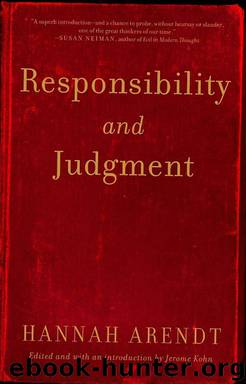
Author:Hannah Arendt [Arendt, Hannah]
Language: eng
Format: epub
ISBN: 978-0-307-54405-6
Publisher: Knopf Doubleday Publishing Group
Published: 2002-12-31T16:00:00+00:00
This interpretation is traditional insofar as it insists on the bro-kenness of the will whose inner paralysis, according to Christian or Pauline teachings, can only be healed through divine grace. It deviates decisively from this interpretation only in that it believes it detects within the inner household of the will a kind of tricky device, by virtue of which we are enabled to identify ourselves only with the commanding part, and to overlook as it were the unpleasant, paralyzing sentiments of being coerced and hence of being called upon to resist. Nietzsche himself calls this a self-delusion, albeit a wholesome one. By identifying ourselves with the one who issues the commands, we experience the feeling of superiority which comes from wielding power. This description, one is inclined to think, would be accurate if willing could ever exhaust itself in the mere act of willing, without having to go on toward performing. The brokenness of the will, as we saw, becomes manifest when it comes to performance, and the sentiments which a blissful self-delusion overcomes as long as I am not called upon to deliver the goods, so to speak, ceases when it is discovered that velle and posse, the I-will and the I-can are not the same. Or, to put it into Nietzschean terms: “The will wants to be master of himself” and learns that if the mind commands itself and not merely the body (where it is obeyed instantly, as Augustine told us), this means that I make a slave of myself—that I drag, as it were, the master-slave relationship, whose essence is the denial of freedom, into the intercourse and the relationship which I establish between me and myself. Hence, the famous harborer of freedom turns out to be the destroyer of all freedom.20
And yet there is an important new factor thrown into this discussion not mentioned before, the element of pleasure, which Nietzsche understood as inherent in the feeling of having power over others. Nietzsche's philosophy therefore rests on his equation of the will with will-to-power; he does not deny the broken-ness of the will into two which he calls the “oscillations between yes and no” (Will to Power, no. 693), the simultaneous presence of pleasure and displeasure in every act of willing, but he counts these negative feelings of being coerced and of resisting among the necessary obstacles without which the will would not know its own power. Obviously, this is an accurate description of the pleasure principle; the mere absence of pain cannot cause pleasure, and a will that does not overcome resistance could not awaken pleasant feelings. Nietzsche, wittingly following the ancient hedonist philosophies which had been somewhat reformulated by modern sensualism, especially by Bentham's “calculus of pain and pleasure,” relied in his description of pleasure on the experience of being released from pain, and neither on absence of pain nor on sheer presence of pleasure. The intensity of this sensation of being released from pain is beyond doubt; in intensity it is matched
Download
This site does not store any files on its server. We only index and link to content provided by other sites. Please contact the content providers to delete copyright contents if any and email us, we'll remove relevant links or contents immediately.
The remains of the day by Kazuo Ishiguro(9013)
Tools of Titans by Timothy Ferriss(8413)
Giovanni's Room by James Baldwin(7360)
The Black Swan by Nassim Nicholas Taleb(7142)
Inner Engineering: A Yogi's Guide to Joy by Sadhguru(6804)
The Way of Zen by Alan W. Watts(6623)
The Power of Now: A Guide to Spiritual Enlightenment by Eckhart Tolle(5799)
Asking the Right Questions: A Guide to Critical Thinking by M. Neil Browne & Stuart M. Keeley(5788)
The Six Wives Of Henry VIII (WOMEN IN HISTORY) by Fraser Antonia(5523)
Astrophysics for People in a Hurry by Neil DeGrasse Tyson(5197)
Housekeeping by Marilynne Robinson(4462)
12 Rules for Life by Jordan B. Peterson(4316)
Ikigai by Héctor García & Francesc Miralles(4285)
Double Down (Diary of a Wimpy Kid Book 11) by Jeff Kinney(4283)
The Ethical Slut by Janet W. Hardy(4270)
Skin in the Game by Nassim Nicholas Taleb(4263)
The Art of Happiness by The Dalai Lama(4136)
Skin in the Game: Hidden Asymmetries in Daily Life by Nassim Nicholas Taleb(4016)
Walking by Henry David Thoreau(3973)
